Compare · OpenShorts
OpenShorts vs Vidione: Clip Long Videos or Create New Ones
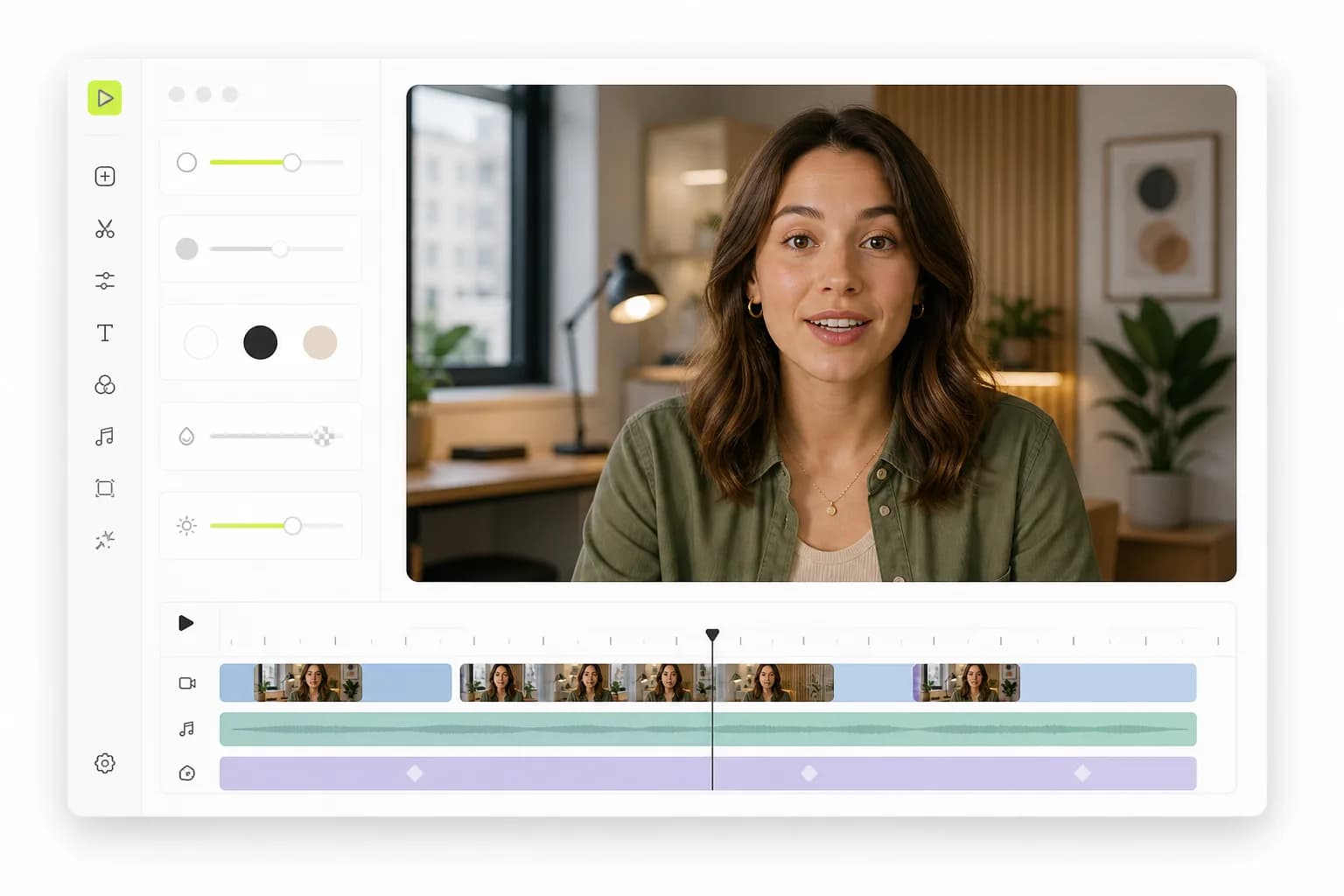
OpenShorts is an open-source clipper that turns long videos into vertical shorts, free to self-host. Vidione does a different job: it makes a lip-synced talking video from a photo and a script, then captions and edits it in the browser, from $12 for your first month.
- No auto-clipping: we say so up front
- No API keys to bring: credits cover generation
- Scripts up to 2,000 characters
- Your own voice, up to 4 speakers
Updated November 14, 2026
Our take
OpenShorts vs Vidione: the short verdict
OpenShorts and Vidione do different jobs, so start with the footage. If you have long videos, podcasts, streams or interviews, and want shorts cut from them, use OpenShorts: it finds 3 to 15 moments, reframes them to 9:16 around the speaker and burns in captions. It is open source under the MIT licence, free to self-host, and its cloud starts at $12 a month for 100 source minutes. Vidione has no auto-clipping. It is for the case where you have no footage: upload a photo or pick one of 45 library characters, write a script of up to 2,000 characters, and Vidione makes a lip-synced talking video at 15 credits per second, with no outside API keys. OpenShorts also has an AI actor tool, but it makes 20 to 25 second product ads and bills video generation to your own provider keys.
Pick Vidione if you…
- Need a talking video of any length up to a 2,000-character script, not only a 25-second ad
- Want generation included in one plan, with no third-party accounts or keys to manage
- Want your own cloned voice, or up to 4 characters talking in one script
- Want word-level auto subtitles on every video you make, at no extra credits, plus an SRT file
- Want to cut, trim and caption in a browser editor, then export MP4 or a CapCut project
Pick OpenShorts if you…
- Already have long videos and want many shorts cut from them automatically
- Want open-source code you can run on your own hardware with no usage cap
- Want posting to TikTok, Reels and Shorts, plus an API, MCP server and CLI
- Your first Vidione month (then $25)
- $12
- Characters in one Vidione talking-video script
- 2,000
- OpenShorts self-hosted, MIT licence, your own keys
- $0
- OpenShorts Cloud Starter per month, 100 source minutes
- $12
What OpenShorts does, and what Vidione doesn't do
OpenShorts is an AI clip generator. You paste a YouTube, Twitch or Kick link or upload a file, and it scores the transcript and scenes, keeps 3 to 15 moments of 15 to 60 seconds, reframes them to 9:16 with face tracking, adds word-level subtitles and hook titles, and can post to TikTok, Instagram Reels and YouTube Shorts. You can run the same code with Docker on your own machine or use the hosted OpenShorts Cloud.
Vidione does not do that. To be plain about it:
- No auto-clipping. Vidione does not scan a long video and pick highlights. An "AI Clips" tool is shown in the editor menu, but it is marked coming soon.
- No auto-reframing from 16:9 to 9:16, and no viral score.
- No translation or dubbing yet. That menu item is also marked coming soon.
- No posting, no self-hosting and no public API. You download the file and post it yourself.
What Vidione does is create the video: a talking photo from one image and a script, in 9:16 or 16:9, with lip sync and a voice.
Where OpenShorts falls short, and why some people look for an OpenShorts alternative
OpenShorts is a strong, honest clipper. These are the limits that matter if your problem is not clipping, all from OpenShorts' own pages as of November 2026.
- The clipper needs footage. Every clip is cut from a video you supply. With no recording, there is nothing to clip.
- The AI actor tool is narrow. OpenShorts' AI Shorts writes 20 to 25 second product ads in English or Spanish, in a fixed five-beat shape. It lists no multi-character scripts and no long presenter videos.
- Generation runs on your own keys. The actor image, talking head, lip sync and voice are billed by outside AI providers to keys you connect, about $0.65 to $2.50 a video, on Cloud and self-hosted alike.
- Self-hosting is work. You install, maintain and back it up; it needs Docker and 8 GB+ of RAM, and an 8-minute video takes 5 to 8 minutes on a typical CPU.
- The free Cloud plan is watermarked.
If you want one subscription that makes the talking video for you, an OpenShorts alternative built for creation fits better. See also AI avatars and the Vidione alternatives page.
OpenShorts vs Vidione feature comparison
What each product offers as of November 2026. "Not listed" means we found it nowhere on the OpenShorts home, pricing, AI Shorts or source-code pages.
Swipe the table to compare
| Feature | Vidione | OpenShorts |
|---|---|---|
| Main job | Create talking videos from a photo and a script | Cut long videos into shorts |
| Auto-clipping of long videos | No (AI Clips is marked coming soon) | Yes, 3 to 15 clips per video |
| Auto-reframing to 9:16 | No | Yes, face tracking, two speakers stacked |
| Open source and self-hosting | No | Yes, MIT licence, Docker |
| Talking video from a photo and script | Yes, scripts up to 2,000 characters, 9:16 or 16:9 | AI Shorts: 20 to 25 second product ads, 9:16 |
| Who pays for generation | Included in plan credits | Your own provider keys, about $0.65 to $2.50 a video |
| Voice cloning | Yes, from an uploaded or recorded clip | Through your own voice-provider key: dubbing keeps the speaker's voice, AI Shorts can use voices you cloned there |
| Several speakers in one script | Up to 4 characters | Not listed |
| Auto subtitles | Word-level on videos made in Vidione, 5 styles, editable words, no extra credits | Word-level, 17 caption styles |
| Editor | Timeline: split, trim, text, music, background removal | Clip editor, hook overlays, AI effects |
| Export | MP4 up to 1080p, SRT file, CapCut project | MP4; AI Shorts at 1080x1920 |
| Publish and schedule | Download only | TikTok, Instagram Reels, YouTube Shorts |
| Dubbing | Not yet (marked coming soon) | 30+ languages with your own voice-provider key |
| API and agents | Not offered | REST API, MCP server, CLI |
| Free start | No; $12 first month | Free Cloud plan (watermarked) or free self-hosting |
Try the parts Vidione does well: auto subtitles, voice cloning and the video editor.
OpenShorts pricing vs Vidione pricing (as of November 2026)
List prices in US dollars. OpenShorts Cloud sells minutes of source video you clip; Vidione sells minutes of finished, generated video. The last column is what one unit costs.
Swipe the table to compare
| Plan | Price | Includes | Per unit |
|---|---|---|---|
| Vidione Creator | $25/mo ($12 first month) | 5 finished minutes (4,500 credits) | $5.00 a finished minute |
| Vidione Starter | $99/mo | 20 finished minutes (18,000 credits) | $4.95 a finished minute |
| Vidione Pro | $199 or $599/mo | 45 or 150 finished minutes | $4.42 or $3.99 a finished minute |
| OpenShorts self-hosted | $0 (MIT) | No cap; your hardware and API keys | Your own costs |
| OpenShorts Cloud Free | $0 | First video up to 60 min, then 20 min a month, watermarked | Free |
| OpenShorts Cloud Starter | $12/mo, or $10/mo yearly ($120) | 100 source minutes a month | $0.12, or $0.10 yearly, a source minute |
| OpenShorts Cloud Creator | $29/mo, or $24.17/mo yearly ($290) | 300 source minutes a month | $0.097, or $0.081 yearly |
| OpenShorts Cloud Pro | $59/mo, or $49.17/mo yearly ($590) | 750 source minutes a month | $0.079, or $0.066 yearly |
OpenShorts extra minutes: 60 for $9 or 200 for $25, and they don't expire. Vidione subscribers can add minutes at $5 each, 10 minimum; Vidione credits reset at each renewal and don't roll over. OpenShorts AI Shorts videos are billed separately by the providers on your keys. Full Vidione plans are on the pricing page.
Is OpenShorts free, and which costs less per video?
Yes, OpenShorts can be free: the self-hosted edition is MIT-licensed with no watermark and no cap, and the Cloud has a free plan of 20 minutes a month with a watermark. Vidione has no free plan or trial; Creator is $12 for the first month, then $25.
Which costs less depends on what you are making.
- You have long videos. OpenShorts wins easily. A 40-minute podcast uses 40 of Starter's 100 minutes, whatever the clip count. Vidione can't clip it at all.
- You want a 25-second product ad with an AI actor. OpenShorts Low Cost mode is about $0.65 in provider fees on your keys. On Vidione, 25 seconds is 375 credits, about $2.08 at the $25 Creator price, with no keys to set up.
- You want a longer talking video. A 60-second script on Vidione is 900 credits, one of Creator's 5 minutes. OpenShorts AI Shorts stops at 25 seconds by design.
So pick on the job, then compare price.
When OpenShorts is the better pick
If you already record long videos, OpenShorts is the better tool, and no OpenShorts alternative on this page competes with it there. It is open source, it can run on your own hardware so the video never leaves it, and the hosted plans are among the cheapest clippers to start with.
- You publish a podcast, stream or sermon every week and want daily shorts from it.
- You want to self-host for privacy, or automate clipping through an API, MCP server or CLI.
- You want quick, cheap 25-second product ads and are happy to manage your own provider keys.
When Vidione is the better OpenShorts alternative
Vidione is the better OpenShorts alternative when the problem is making the video, and you want the whole job in one subscription.
- No footage, no keys: upload a photo or pick one of 45 library characters, type up to 2,000 characters of script and choose a voice. Vidione returns a lip-synced talking photo in 9:16 or 16:9, paid from your plan's credits.
- Your own voice: clone it in voice cloning from a clip you upload or record, after agreeing to the terms.
- Dialogue: write one script for up to 4 characters, each with a tag, and they speak in turn.
- Captions and cuts: generate auto subtitles with the spoken word highlighted, click any word to fix it, split and trim on the timeline, then export MP4, an SRT file or a CapCut project.
You see the credit cost as you type the script. A generation that fails returns its credits automatically.
How to use Vidione next to OpenShorts
You don't have to choose one. OpenShorts cuts what you film; Vidione fills the days you have nothing to film.
Step 01
Keep OpenShorts for long videos
Run podcasts, streams and interviews through OpenShorts, self-hosted or on Cloud. Note which topics score highest, since they make good scripts.
Step 02
Write a short script
Turn one strong idea into a script of up to 2,000 characters. Use tags if you want 2 to 4 characters to talk to each other.
Step 03
Make the talking video
In Vidione, upload a photo or pick a library character, choose a preset or cloned voice and generate. The cost, 15 credits per second, shows before you click.
Step 04
Caption, export, post
Add auto subtitles, pick a caption style, download the MP4 and post it with your OpenShorts clips.
Running a fair OpenShorts vs Vidione test
These tools solve different problems, so test each on the job it was built for.
Do
- Give OpenShorts a real long video with clear speech
- Give Vidione a script you would otherwise have to film
- Add provider fees to OpenShorts AI Shorts when you compare ad costs
- Count the minutes you spend fixing each result
Don't
- Expect Vidione to find highlights in a long video; it can't
- Expect the OpenShorts clipper to make a video from a script with no footage
- Compare a source minute with a finished minute directly
- Clone a voice or animate a face you have no right to use
More Vidione tools and comparisons
The Vidione pages that do the work, and other clipper comparisons.
Frequently asked questions
Is OpenShorts really free and open source?
Yes. OpenShorts is open source under the MIT licence, and the self-hosted edition is free with no watermark and no usage cap: you run it with Docker and bring your own API keys. The hosted OpenShorts Cloud has a free plan of 20 minutes a month with a watermark, and paid plans from $12 a month, as of November 2026.
Is Vidione a good OpenShorts alternative for clipping long videos?
No. Vidione has no auto-clipping, so it can't cut a long video into highlights, reframe it or score moments. If that is the job, keep OpenShorts. Vidione is the better fit when you have no footage: it makes a lip-synced talking video from a photo and a script, then adds word-level subtitles you can edit.
How much does OpenShorts Cloud cost compared with Vidione?
As of November 2026, OpenShorts Cloud is $12, $29 or $59 a month for 100, 300 or 750 source minutes, or about 17% less billed yearly. Vidione is $25 a month for 5 finished minutes, $99 for 20 and $199 for 45 or $599 for 150. They meter different things: video you clip versus video that is generated for you.
Can OpenShorts make talking avatar videos too?
Partly. Its AI Shorts tab writes a 20 to 25 second product ad in English or Spanish and has an AI actor, or your own photo, say it with lip sync. The generation is billed by outside providers to your own keys, about $0.65 to $2.50 a video. Vidione makes talking videos from scripts of up to 2,000 characters, with credits included and up to 4 characters.
Do I need my own API keys with Vidione?
No. Vidione runs the talking-video generation on our side and charges it to your plan's credits, 15 per second of finished video, so there are no outside accounts or keys to set up. You see the cost as you type the script, and a generation that fails returns its credits automatically.
What do I need to run OpenShorts on my own computer?
Self-hosting OpenShorts takes Docker, 8 GB or more of RAM and model downloads, plus an AI key or a local model to find the moments, and provider keys for AI Shorts or dubbing. An NVIDIA GPU helps: on a typical CPU an 8-minute video takes 5 to 8 minutes, against about 50 seconds on the hosted Cloud.
Are Vidione's auto subtitles really free of credits?
Yes, for videos you make in Vidione. Generating their subtitles uses no extra credits. You get word-level captions with the spoken word highlighted, 5 caption styles and a one-word-at-a-time mode, and you can click any word to fix it. Captions are burned into the MP4 export or saved as an SRT file.
Does Vidione translate or dub videos like OpenShorts can?
Not yet. Vidione's AI Dubbing tool is marked coming soon in the editor, so there is no translation or dubbing today. OpenShorts can dub a clip into 30+ languages if you connect your own voice-provider key. If you need a dubbed version now, OpenShorts or a dedicated dubbing tool covers it.
No footage for OpenShorts to clip? Create it
Turn a photo and a script into a talking video, with no API keys, then caption it at no extra credits. $12 for your first month.
Create a talking video